
Table of Contents
Capacity utilization — the root cause is “a flat bottom”
A systematic solution: the new-generation Storm Air Cannon at its core
Why it is called a “systematic solution”
Ansteel project case
Is your silo sitting half empty?
Free capacity diagnosis
Capacity utilization — the root cause is “a flat bottom”
Materials that are fine and wet have poor flowability and easily agglomerate and harden under pressure. A flat-bottom silo has no conical inclination, so material can only self-flow from the center, and the corners and edges readily accumulate into dead-stock zones. And it is not just inside the silo. The vertical chute beneath the silo suffers from wall build-up, scaling, bridging and arching with fine, wet material; if the pile grows without being loosened, material can even spurt out. Disk feeders with improper baffle angles and no auxiliary flow aid bridge frequently at the outlet, feeding erratically—on and off. One end cannot discharge cleanly; the other cannot feed steadily; naturally the silo never fills up. The effective capacity of such silos often stays below 40% for long periods.
| Capacity-loss symptom | Root cause | Devondi solution |
| Effective capacity stuck below 40% | Flat bottom has no conical inclination; material only self-flows from the center, leaving dead-stock zones at corners and edges | Storm Air Cannon (DFD-191A-W01) arranged in two layers inside the silo punctures the arching layer and releases dead-stock zones |
| Chute wall build-up, bridging, arching, spurting | Fine, wet material on the vertical chute; the pile grows without being loosened | Intelligent anti-clogging terminal + FBC Chute Free-Flow System keeps the chute clear |
| Feeder bridges intermittently | Disk feeder baffle angle improper, no auxiliary flow aid | Linear vibrator + controlled discharge within a five-layer closed loop that auto-senses and clears |
| Reliance on manual cleaning, safety risk | No active flow aid; periodic human entry required | Remote control + sense–decide–execute–optimize loop, eliminating manual entry |
A systematic solution: the new-generation Storm Air Cannon at its core
Devondi’s approach places its independently developed new-generation Storm Air Cannon (DFD-191A-W01) at the core: arranged in two layers, upper and lower, inside the silo, its measured single-impact force reaches 80,000 newtons—equivalent to the force of roughly 8 tonnes pressing down instantly—puncturing the arching layer in a flash and breaking up dead-stock zones and wall build-up. Layered on top are the intelligent anti-clogging terminal, linear vibrator and remote control, strung into a “sense–decide–execute–optimize” closed loop: material shifts from being forced out by its own weight to flowing out in a controlled way, and silo capacity is released bit by bit.
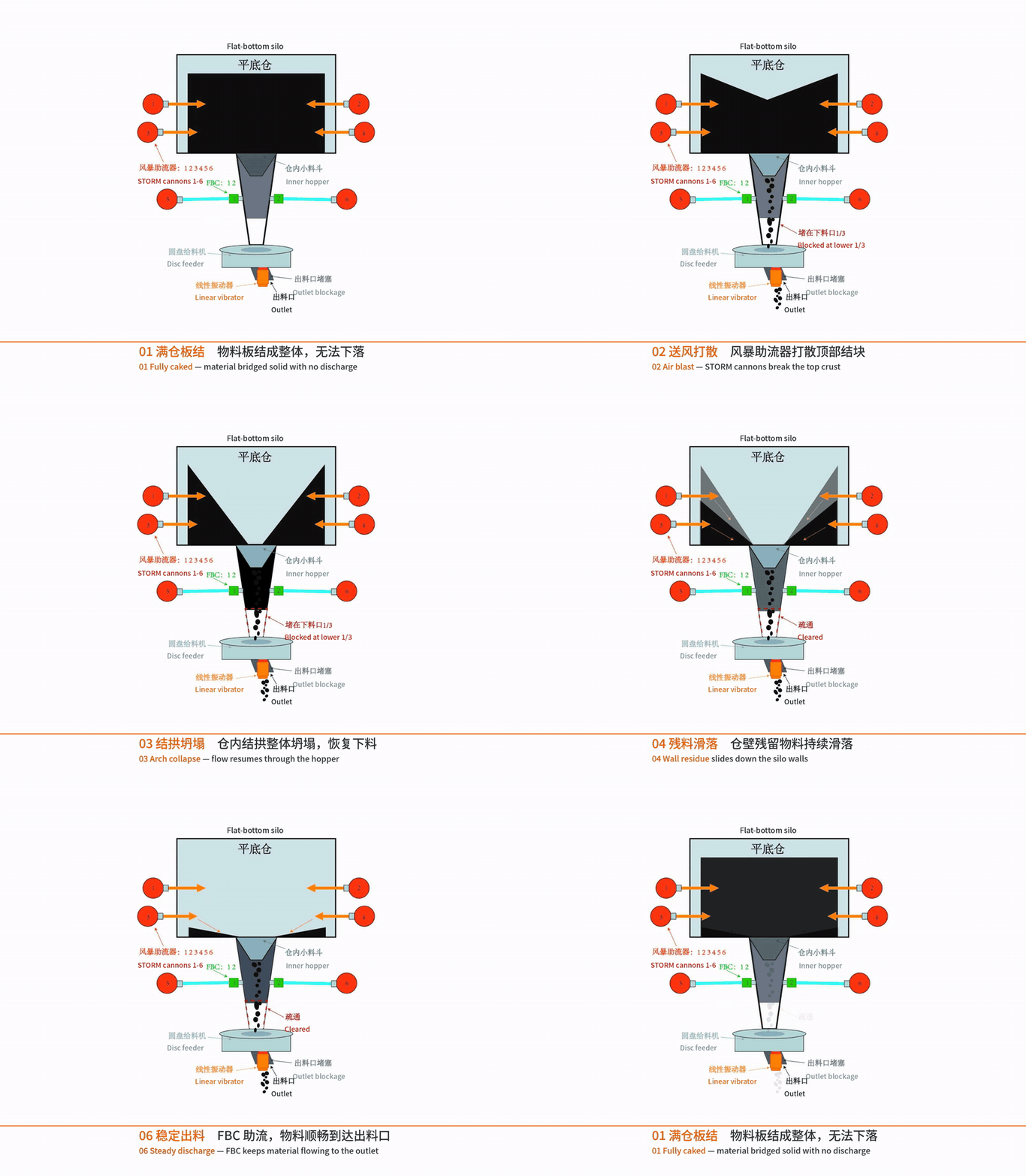
In the past it was believed that raising a flat-bottom silo’s utilization required modifying the silo geometry; now, with this flow-aid capability, a flat-bottom silo no longer has to pay for its dead zones—retaining its advantages of simple structure and low cost, and using equipment to fill its capacity. From “changing the silo geometry” to “changing the flow,” Devondi used one system to rewrite the industry’s design understanding of flat-bottom silos.
Why it is called a “systematic solution”
A flat-bottom silo’s blockage is never in just one place. Material, silo geometry, chute and feeder—each one drags capacity down. The Storm Air Cannon resolves the “dead-stock zone,” the blockage that most affects capacity, but to truly fill the silo, the chute, discharge opening and control must all keep pace.
Devondi’s solution strings five layers—material state, silo body, chute, feeding and control—into one closed loop that automatically senses and handles any place that is not flowing smoothly. This is also why capacity can rise from 40% to above 70%—not because one machine works a miracle, but because every blockage point is cleared systematically.
Ansteel project case
Take an iron-ore dressing plant of Ansteel Mining Resources Utilization (Anshan) Co., Ltd. as an example: a 12 m-diameter flat-bottom silo handling fine, wet iron concentrate had an effective capacity utilization of less than 40% before retrofit and relied on manual cleaning for a long time. About 6 weeks (45 days) after the Storm Air Cannon system went live, utilization stabilized above 70%, releasing about 600 tonnes of additional capacity per silo, with the retrofit payback in about 2 months.

Is your silo sitting half empty?
If your site matches any of the following, your capacity is likely sitting empty for nothing:
- Flat-bottom silo clogs frequently—cleared, then clogged again
- Material level is never full, yet at peak season you still feel there is nowhere to store
- Forced to rent off-site space to store material
- Peak production is bottlenecked by capacity, and output cannot go up
When you hit these situations, don’t rush to expand the silo. First see whether your existing capacity is being fully used. Often the problem is not that the silo is too small, but that it is not being used well.
Free capacity diagnosis
Send us your silo geometry and dimensions, material characteristics and blockage locations, and Defengdi engineers will run a free capacity diagnosis and calculate how much more material this silo can release.
FAQ
Nova, Flow Applications Engineer at DEVONDI.